Creative Is the New Targeting: How Meta’s AI Stack Decides Who Sees Your Ads

At a Glance...
Meta’s AI systems – GEM, Lattice & Andromeda – now determine how ads are interpreted, matched and retrieved. As manual targeting declines in influence, creative has become the primary performance lever. This article explains how the system works and what marketers must change in response.
2025 marked a structural reset for performance marketers. AI is no longer a feature layered onto campaign management, it’s the operating system. Automated bidding, predictive modelling and generative creative are not isolated features – they sit within large-scale systems that determine how ads are interpreted, matched and delivered. As the user, these behind-the-scenes changes aren’t visible, you’re experience in Instagram and Meta is still the same. For marketers, you’ll need to know how these systems work together, and how to meet the requirements for growth.
On Meta, this shift is driven by a trio of AI models: GEM, Lattice & Andromeda. Together, they have changed where performance leverage sits. Platforms now decide who sees your ads, and advertisers decide what signals those systems receive.
Historically, targeting was treated as a primary growth lever. Lookalikes were refined, and layered interests to continually narrow and specify audience segments. This segmentation was then paired with hyper-relevant creative – e.g. ‘those interested in triathlons, living in Metropolitan areas, age 40+ will be interested in this exact product’. The assumption was that manual controls would outperform automated learning. That assumption no longer holds.
So, what does this mean when it comes to performance strategy? Here’s how to stay agile with the latest changes.
The Meta system trio: GEM, Lattice & Andromeda
Meta’s delivery system now operates across three interconnected layers:
- GEM (Global Embedding Model) helps the platform understand content. It analyses creative elements – imagery, language, format and context – and translates them into structured data that the system can interpret.
- Lattice maps behavioural patterns. It connects user actions, interests and intent signals across Meta’s ecosystem, building predictive representations of what people are likely to engage with.
- Andromeda sits at the retrieval layer. Before bidding even begins, it selects which ads enter the auction for a given user, based on predicted relevance.
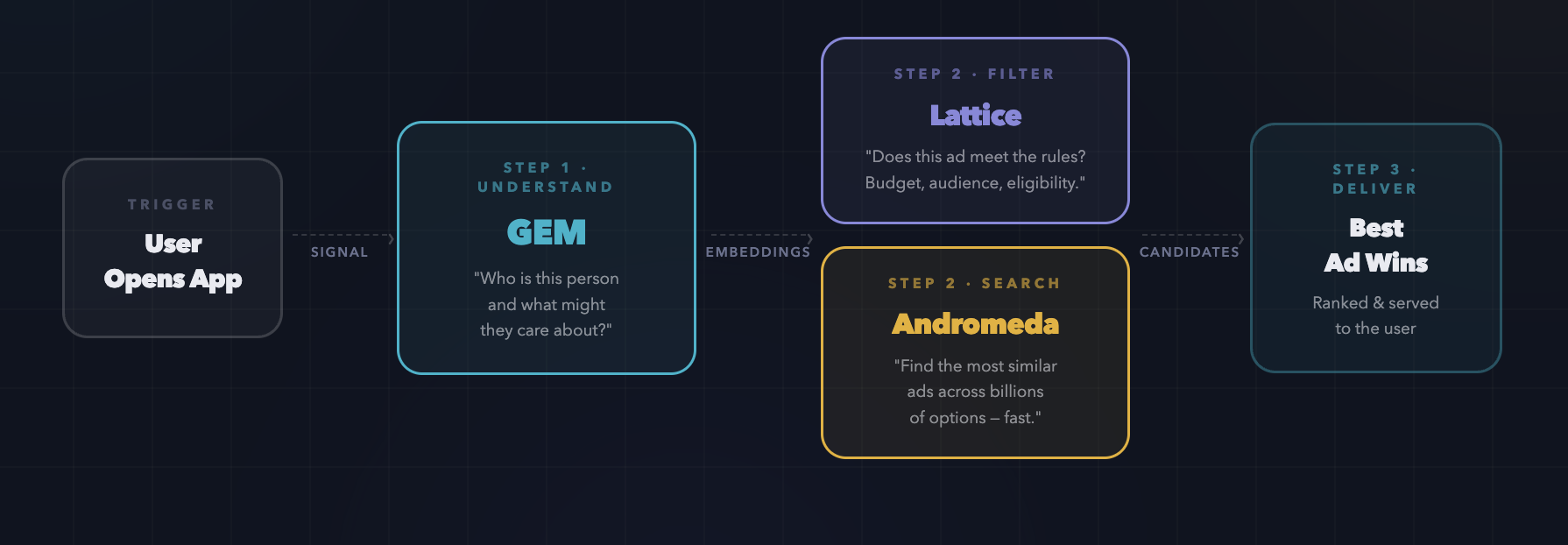
In summary, GEM understands the ad, lattice understands the user, and Andromeda matches the two. These all work together; there’s no toggle to turn them on or off. They are already the environment in which marketers are operating in.
The way the system matches an ad to a user is based on learned patterns across billions of interactions. If certain creative structures correlate strongly with certain behaviours, the system internalises the relationship. Ads are retrieved not because they were assigned to a tightly defined audience, but because their creative signals align with predicted user intent.
This is the practical example of “creative is the new targeting”. The asset itself contains the signal and becomes a readable input across all three systems.
Defining your creative strategy
If Andromeda decides which ads even enter the bidding auction, creative decisions will influence if your ad gets considered at all. We’ve then got GEM interpreting the ads visuals and messaging, so clarity and distinction matter. Lattice is then mapping behavioural likelihood, so signal strength determines the ads reach,
When multiple ads share the same visual structure, framing, in-ad copy etc, the system reads them as similar signals. Subtle tweaks will be indistinguishable at scale. Therefore, marketing focus should be on campaign simplification and creative diversification. Fewer campaigns and broad targeting to allow the algorithm to explore and find users, more creative variation to give it meaning differences to learn from. The more distinct your ads, the easier the system can map audience responses.
In short, that means focusing less on polished and overproduced ad refinement and manual control, and more on signal engineering. Here’s how that looks in practice:
Do:
- Display products or subjects in different settings
- Test both polished and lo-fi approaches
- Feature different text formats e.g. questions, lists, quotes
Don’t:
- Rely on subtle shifts that maintain the same visual concept
- Use the same in-ad test for multiple ads
- Address too narrow an audience
- Assume high-spec, high-production ads are best


Tying this back to the trio, we’ve then got GEM interpreting the ads visuals and messaging, so clarity and distinction matter. Lattice is then mapping behavioural likelihood, so signal strength determines the ads reach.
Reframing performance
The previous performance model was centred on granular targeting, supported by periodic creative refreshes. The emerging model centres on broad targeting powered by continuous and structured creative iteration. Meta’s AI stack doesn’t take away the marketer’s role and the overarching strategy; it just changes the requirements. Strong performance depends on how effectively creative feeds GEM, Lattice and Andromeda. Produce creative that communicates clearly, has a wide and purposeful variety, and gives the system strong, easy-to-read signals.
Want to know more about how In Digital can help? Get in touch for a chat.
Kate Lindars, Associate Director
Ready to improve your performance?
Reach out to one of our team to learn more about our services and how we can help your business thrive.